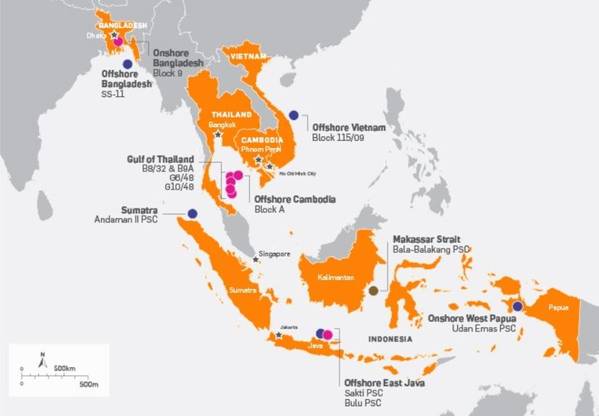
Southeast Asia-focused oil company KrisEnergy has agreed to transfer its Block 115/09 offshore Vietnam to an undisclosed international oil company.
Debt-laden KrisEnergy said it would transfer its entire 100% working interest in Block 115/09 for nominal cash consideration, to reduce liabilities, and spend limited cash available on near term development.
"The consideration was arrived at taking into account that the transfer of the exploration block reduces the Company's liabilities and mandatory work commitments comprising a 3D seismic acquisition program of at least 850 sq. km along with the processing of the data and the drilling of one exploration well," KrisEnergy said.
"The Board believes it is more prudent to allocate KrisEnergy's limited capital to funding near-term development, in particular the development of the Apsara oil field in Cambodia Block A," KrisEnergy said.
The transfer of Block 115/09 working interest and operatorship is subject to a number of conditions, including approvals from the relevant government authorities. The long stop date for the farm-out agreement is 30 June 2020.
"Further details of the transfer will be announced by the Company as and when necessary," KrisEnergy said.
Cambodia's first offshore development
As mentioned by KrisEnergy, the company's near-term focus is on the Apsara oil field development, which will be Cambodia's first offshore oil development in production.
The Apsara field in Cambodia Block A lies over the Khmer Basin, an unproduced geological basin in the Cambodian maritime waters of the Gulf of Thailand.
The company in November last year ordered a minimum facilities wellhead “mini-platform” for the Apsara oilfield from Profab in Indonesia.
Due to the unproven production performance of the basin, the development of the Apsara area will be carried out be in several phases to mitigate risk and provide time for the collection and analysis of critical data to be applied in future phases.
The Mini Phase 1A, comprises the Mini-Platform and five initial development wells connected to the Ingenium II production barge for oil, gas and water processing. Shuttle tankers will transport crude oil from the barge.
Apsara oil is scheduled to flow in the first half of 2020 and the field is expected to reach a peak rate of 7,500 barrels of oil per day.
The first steel for MiniPlatform was cut in December 2019.

 Subscribe