Compute Maritime, the deep tech company behind NeuralShipper, the world's first Al platform for ship design, has revealed the results of its UK Government-funded project, GenDSOM, to bring generative Al and additive manufacturing into ship design.
Working with consortium partners Siemens Digital Industries Software, Rapid Fusion, HP, BYD Naval Architects and the University of Southampton, the project has produced a next-generation crew transfer vessel (CTV) for the offshore wind sector that, in detailed performance modeling, saves 101,671 liters of fuel and 258.7 tons of CO2 per vessel every year compared with a conventional baseline.
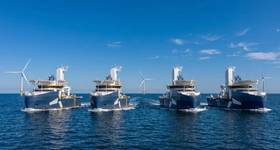
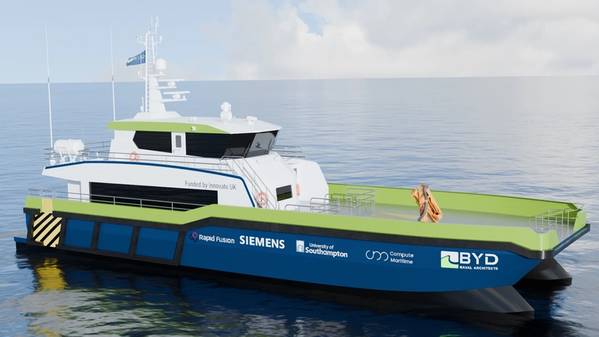
The designed vessel, a 32.5-meter twin-hull CTV designed by BYD Naval Architects and built to carry 24 offshore wind technicians and four crew, was developed using Compute Maritime's Neural Shipper Al to optimize its hull form, then paired with a diesel-electric hybrid propulsion system, developed with Siemens Energy.
The combined result is an 11.1% reduction in annual fuel consumption and an 8.9% reduction in CO2 emissions against a like-for-like conventional diesel vessel operating the same offshore wind duty cycle.
One finding underlines why the Al optimization matters so much. Modeled across a full day of operations, the baseline vessel ends the day with a 34 kWh energy deficit, drawing the batteries beyond their safe discharge limit and falling short of the 25-knot service speed. The Neura Shipper-optimized vessel reverses this, finishing the day with a 106 kWh surplus, comfortably within the battery's operating envelope and delivering full service speed.
At the heart of the saving is the hull itself. NeuralShipper generated and refined a hull form that reduces the power required at the vessel's 25-knot service speed by 6.3%, with reductions of up to 11.6% at higher speeds. Because a crew transfer vessel spends its working life making repeated high-speed transits to and from wind farms, even a single-digit cut in required power compounds into tens of thousands of liters of fuel saved across a year of operations.
GenDSOM advances manufacturing as well as design. As part of the project, Compute Maritime and Rapid Fusion developed a complete additive-manufacturing toolset that brings production constraints, such as build volume, support structures and material behavior, directly into the NeuralShipper design loop, so that components are optimised to be printable from the outset rather than reworked for manufacture afterwards. Using this approach, the consortium designed and produced a hydrofoil with Rapid Fusion's Apollo, a robotic large-format additive manufacturing (LFAM) system that uses high-deposition pellet printing to build large composite and thermoplastic components. The result is a working demonstration of an unbroken pathway from Al-generated geometry to a finished, production-ready marine component.
The vessel has been designed as a future-proof, upgradeable platform. By specifying an offshore fast-charging inlet at the build stage, it is ready to draw power from the charging infrastructure that wind farm operators are beginning to install at sea. As that infrastructure and the wider electricity grid continue to decarbonize, the vessel can progressively shift from diesel to battery power with no change to its core propulsion system, on a roadmap that points toward emissions reductions of around 95% over its 25-year service life.
GenDSOM responds directly to the UK's 2025 Maritime Decarbonisation Strategy, which targets emissions reductions of 30% by 2030 and 80% by 2040 for domestic maritime. Decarbonizing smaller working vessels such as crew transfer vessels, which operate intensively and in growing numbers across the UK's expanding offshore wind fleet, is recognized as critical to meeting those targets.
GenDSOM is funded by the UK Government through the UK Shipping Office for Reducing Emissions (UK SHORE) program in the Department for Transport. Innovate UK, part of UK Research and Innovation, is the main delivery partner for UK SHORE interventions.

 Subscribe