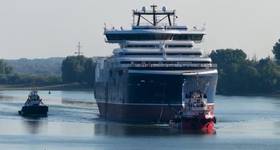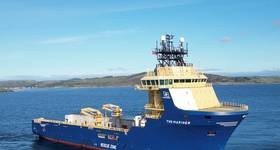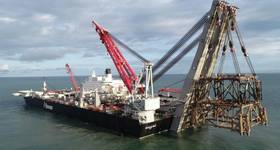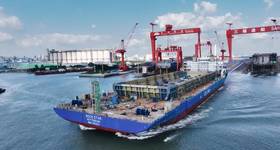
Over the last few years, the energy trilemma has pivoted away from energy transition to energy security and affordability. As a result, offshore oil & gas exploration and production activity, including deepwater activity, has been relatively healthy. Construction, operational support and decommissioning activity has supported the deployment of large anchor handlers and MSVs.
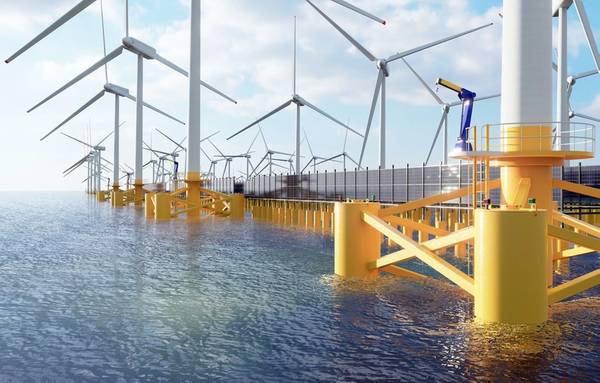
At the same time, the global floating offshore wind forecast has “moved to the right” due to cancelled projects, disappointing auctions, cost increases and political headwinds. Within the offshore wind sector, floating wind remains an emerging technology. The 2035 commissioned floating wind capacity forecast is ~5GW, rising to ~14GW by 2040.
Despite this less positive floating wind forecast than previously presented, floating wind projects will drive demand (and shortages) for the largest AHTSs and MSVs.
Depending on oil & gas demand for large AHTSs, shortages could appear by 2029-2031 and shortages in large MSV supply could emerge as early as 2030-2031. These are the finding of a new floating wind vessel forecast by Intelatus global partners.
 Source: Intelatus Global Partners
The Variability of Floating Wind Projects
A commercial scale floating wind farm will be made up of a group of turbines supported by floating structures, moored to the seabed by a station keeping system, with generated electricity passed along dynamic array cables, often to a bottom-fixed offshore substation. On the face of it, this sounds simple. It is not – there are many challenges to address, including:
Floating wind projects will rely on vessels built predominantly for oil & gas projects.
As noted above, floating wind projects will rely on large AHTSs and MSVs to pre-lay moorings, tow & hook-up the floating turbines and lay array cables.
The large MSV segment is relatively simple to group in terms of AHC crane size and back deck. To meet the offshore construction schedules of commercial floating projects, Vessels with large back decks, of 2,000 square meters and more, equipped with AHC cranes with capacities of 400 tonnes or more will be required to ensure offshore productivity.
Large AHTSs are more complicated. Not only are high bollard pull vessels required (those with 300 tonnes and more bollard pull) but vessels with large back decks, large chain lockers, large capacity fiber rope winches and high-capacity chain handling equipment. The latter point is often under-looked, but many of today’s anchor handlers are equipped with chain haulers, gypsies, etc. that can handle 76-165mm chain seen in most oil & gas projects, but not the 175-220mm chain anticipated for many floating wind projects.
In addition to large MSVs and AHTSs, floating wind projects will also require smaller support MSVs and AHTSs, where supply is greater.
Is Anyone Building?
Whereas there is new building in the 250t AHC crane MSV segment, there are no 400t AHC conventional MSVs under construction. The same goes for large AHTS. Without a specific long-term charter to back an investment, the economics required to build such vessels are generally missing. Without investment, as floating wind demand grows, vessel supply will become tighter, which will push rates up.
However, there are some moves to build new large anchor handlers.
In Brazil’s deep waters, the world’s largest floating production system market, Petrobras was considering long-term chartering two new build 140m 300t bollard pull mooring pre-lay vessels with larger capabilities than its current 120t torpedo anchors connected by 120mm chain and fiber rope systems. There was talk that the vessels were being specified with both oil & gas and floating projects in mind. The original specification called for vessels capable of carrying 8x160t torpedo anchors (1,500sqm deck) with 150t AHC crane and ≥2,500cbm chain lockers. After industry feedback, the design has now been revised to 4x120t torpedo anchors (840sqm back deck), 4 chain lockers that can store ≥142mm chain, and a 20t crane. The revised specification is suited to oil & gas projects but sub-optimal for commercial scale floating wind projects.
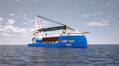
In an interesting move, South Korea’s Hana Shipping recently announced that it is building the world’s first purpose built floating wind installation vessel at China’s Jiangsu Dajin Heavy Industry Co., Ltd. The 127m vessel features a Kongsberg deck machinery package, including a 500t towing/anchor handling winch with three drums and chain handling equipment for 220mm chain, and a MacGregor 400t AHC crane. The vessel will be delivered in 2028 and is intended to be deployed for mooring and cable laying for floating wind projects offshore Ulsan in South Korea.
It is to be seen whether more owners will follow Hana’s example. However, without new vessel investment (and the conditions to support an investment), suitable large AHTS and MSV supply will become an increasingly rare commodity.
Explore the latest edition of Offshore Engineer Magazine which features the piece 'Floating Wind & Deepwater Oil and Gas - Two Worlds Collide' by Philip Lewis, Director Research at Intelatus Global Partners, and many more provided by leading industry experts and journalists.

 Subscribe