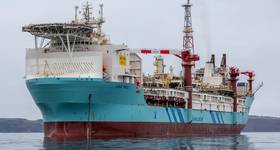
Shell has restarted production at the Penguins field in the U.K. North Sea with a new floating, production, storage and offloading (FPSO) unit.
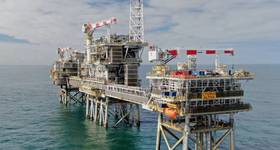
The previous export route for the field, operated by Shell with 50% interest, and partner NEO Energy with the remaining 50%, was via the Brent Charlie platform, which ceased production in 2021 and is being decommissioned.
Peak production is estimated at around 45,000 barrels of oil equivalent per day (boe/d) and currently has an estimated discovered recoverable resource volume of approximately 100 million boe.
Although primarily oil production, Penguins will also produce enough gas to heat around 700,000 UK homes per year.
The new FPSO will have around 30% lower operational emissions compared with Brent Charlie and is expected to extend the life of the field by up to 20 years.
The Penguins FPSO is operated by Shell U.K. Limited, which is a subsidiary of Shell. As announced on December 5, 2024, Shell U.K. and Equinor UK are to combine their UK offshore oil and gas assets and expertise to form a new company which will be the UK North Sea’s biggest independent producer.
On deal completion, the new independent producer will be jointly owned by Equinor (50%) and Shell (50%). The joint venture will take on Shell’s equity interests in Penguins.
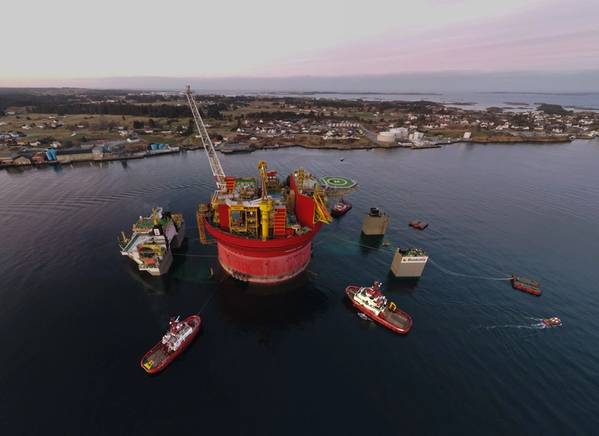
The Penguins FPSO was built by Sevan – a technology, design and engineering company based in Norway – and is the first new Shell-operated facility in the UK North Sea for over 20 years.
It is a compact facility with a cylindrical hull design, providing more efficiency and flexibility. It has a flareless system, which recycles vapour back into the tanks and reduces emissions.
“Today, the UK relies on imports to meet much of its demand for oil and gas. The Penguins field is a source of the secure domestic energy production people need today, and the FPSO is a demonstration of our investment in competitive projects that create more value with less emissions,” said Zoë Yujnovich, Shell’s Integrated Gas and Upstream Director.
Although oil will be transported by tanker to refineries outside of the UK, these include ones that supply refined products like petrol and diesel back to the UK because of its limited refining capacity.
Natural gas will be transported through the existing pipeline to the St Fergus gas terminal in the north-east of Scotland, which supplies the UK’s national gas network.
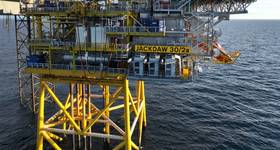
The redevelopment of the Penguins field has involved drilling additional wells, which are tied back to the new FPSO.
The field is in 165 metres (541 feet) of water depth, around 150 miles north-east of the Shetland Islands. Discovered in 1974, the field previously produced oil and gas between 2003 and 2021.

 Subscribe