Oil prices hit multi-week highs on Tuesday after Iran-backed Houthis attacked Saudi energy facilities and Tehran threatened the United States with "economic warfare".
Brent crude futures LCOc1 were up $2.00, or 2.06%, at $99.00 a barrel by 0800 GMT. U.S. West Texas Intermediate crude CLc1 was at $94.41 a barrel, up $2.93, or 3.2%.
Brent earlier rose to as much as $99.22 a barrel, its highest since July 24, while WTI reached $94.60 a barrel, its highest since June 8.
"The price action reflects both genuine physical tightness — tanker flows through Hormuz remain well below normal — and a clear geopolitical risk premium. Right now the risk premium is doing a lot of the heavy lifting," said Tim Waterer, chief market analyst at KCM Trade.
"As for the rest of the year, oil looks set to remain elevated while the Strait stays contested and diplomatic progress remains fragile."
Operations at some energy facilities in Saudi Arabia, the world's top oil exporter, were halted on Tuesday following attacks by Yemen's Iran-aligned Houthis that wounded 73 people, in what Saudi authorities called a dangerous escalation.
Meanwhile, Iran threatened the United States with "economic warfare" and said it had fired an advanced missile at U.S. warships, underscoring the risks of further escalation in the war only days after both sides traded blows again.
On Saturday, U.S. forces had struck three Iranian oil tankers, including one near Kharg Island, Iran's main oil export hub, according to U.S. Central Command. The attacks followed strikes by Iran's Revolutionary Guards on U.S. warships operating in the region.
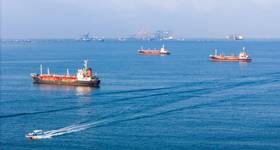
Shipping traffic through the Strait of Hormuz also slowed at the start of this week, after Iran threatened on Monday to retaliate for any new U.S. attacks.
The Strait of Hormuz handled about one-fifth of global daily oil and liquefied natural gas supplies before the conflict began in late February.
"We don't expect a full return to pre-war throughput until late Q1 or early Q2 2027," Daniel Hynes, an analyst at ANZ, said in a note.
Meanwhile, Goldman Sachs raised its Brent and WTI price forecasts by $5 to $85 and $80, respectively, for December 2026 and to $80 and $75, respectively, for 2027, reflecting its new assumption that Middle East shipping disruptions will continue into 2027.
In the product market, global diesel supply will remain tight due to a lack of spare refining capacity, Russia's ban on exports and the approach of peak winter demand, senior industry executives said on Tuesday.
(Reuters - Reporting by Anjana Anil and Anushree Mukherjee in Bengaluru and Emily Chow in Singapore; Editing by Muralikumar Anantharaman, Shri Navaratnam and Susan Fenton)

 Subscribe