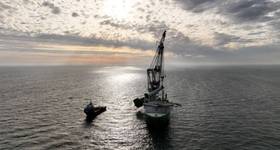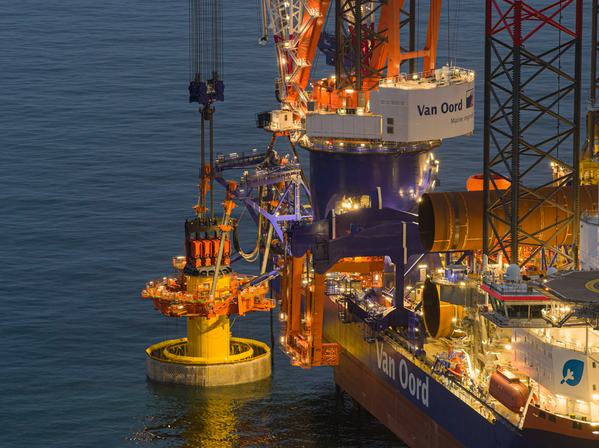
Van Oord has installed three monopile foundations using GBM Works' jetting solution in combination with CAPE’s vibro lifting tool for the first time at commercial scale, a milestone in silent offshore installation.
Designed to reduce underwater noise and minimise impact on marine life, the method was deployed at Ecowende's Hollandse Kust West wind farm using Van Oord's new offshore wind installation vessel Boreas.
GBM Works' VibroJet® technology combines vibrations with controlled water jets inside the monopile to fluidise the soil and reduce resistance.
GBM's in-depth understanding of how water jets interact with different soil conditions allowed for precise operational control, guided by the purpose-built Fluidflow® prediction model.
The technology has demonstrated strong potential in the dense sand layers typical of the Dutch North Sea.
Jan Willem Elleswijk, Project Director at Van Oord, said: “The successful execution demonstrates that large-scale silent installation technologies are maturing rapidly. We are pleased to have applied this innovation as part of the full foundation installation scope at Hollandse Kust West, where all 52 monopiles were installed using our vessel Boreas, once again demonstrating the vessel’s outstanding capabilities.”
The VibroJet® installations were carried out in combination with CAPE Holland's Vibro Technology, which uses vertical vibrations to temporarily reduce soil resistance, allowing monopiles to sink under their own weight.
Marc van Rooijen, Chief Commercial Officer at CAPE Holland, said: “The hard seabed conditions at Hollandse Kust West represent one of the most challenging environments in the Dutch North Sea, which makes this achievement particularly significant. We are proud to have contributed to proving that ecological and efficient can go hand in hand.”
The achievement strongly aligns with Ecowende’s ambition to build the most ecological offshore wind farm to date, with the goal of developing offshore wind in harmony with nature, enhancing the biodiversity of the North Sea and reducing impacts on birds, bats, and marine mammals.
Data collected during the Vibro and VibroJet installations of the monopiles will also validate predictive models for underwater sound and pile behaviour, supporting broader adoption of low-noise installation methods worldwide.
Ecowende is a joint venture between Shell, Eneco and Chubu. Located about 53 kilometres off the Dutch coast near IJmuiden, the wind farm will have an operational capacity of approximately 760 MW, supplying around 3% of the current Dutch electricity demand. Ecowende plans to have the wind farm fully operational and commissioned by the end of 2026.
As Ecowende’s contractor, Van Oord is responsible for transporting and installing the foundations, laying the inter‑array cables, and transporting and installing the wind turbines at sea.

 Subscribe