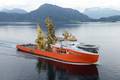
The substructures for fixed offshore wind turbines weigh thousands of tonnes. Only about five vessels in the world can lift that much weight. So now researchers are testing an alternative: an unusually wide barge.
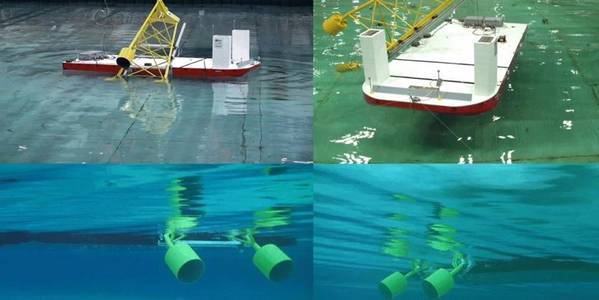
Using experience gained from the oil and gas industry, Aker Solutions, the Belgian contractor Sarens, and the maritime group BOA recently spent time at SINTEF’s Ocean Basin in Trondheim. There they used models to test the feasibility of employing an extra-wide barge to transport several substructures simultaneously. The results are promising.
At 166 meters long and more than 73 meters wide, it would be one of the world’s widest barges. It also can be lowered to a depth of over 30 meters with the deck 22.5 meters below the water surface.
The cargo can either be floated out without a crane vessel altogether or lifted off the barge using smaller, cheaper and more accessible vessels.
In the first round, the team conducted tests as part of the WindRise project to determine whether transporting two substructures on the barge at the same time would be possible – followed by raising them into a standing position at their destination.
“We are very satisfied with the tests that we’ve done so far. The results align well with the numerical analyses that we carried out in advance,” says Robert Indergård, a senior research scientist at SINTEF.
The barge is equipped with both a lifting frame and its own hinge system. The tests showed how this system behaved in different wave conditions.
Work is continuing on how the substructures will be unloaded from the barge and placed in the right position on the seabed.
The players involved in the project say that if they can achieve this, it will help strengthen the Norwegian supplier industry for offshore wind, both nationally and internationally.

 Subscribe