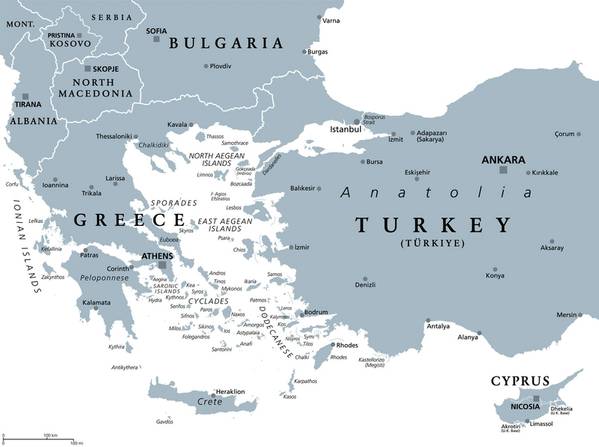
Turkey said on Thursday it opposed Greece's "unilateral activities" in energy fields south of Crete with a consortium led by U.S. major Chevron as a violation of international law and good neighbourly relations.
Athens responded that its policies abide international law.
The Chevron-led consortium signed exclusive lease agreements on Monday to look for natural gas off southern Greece, expanding U.S. presence in the eastern Mediterranean.
"We oppose this unlawful activity, which is being attempted in violation of the 2019 Memorandum of Understanding on Maritime Jurisdiction between Libya and our country," the Turkish Defence Ministry said at a press briefing.
It said the activity, while not directly impacting Turkey's continental shelf, also violated Libya's maritime jurisdiction that was declared to the United Nations in May last year.
"We continue to provide the necessary support to the Libyan authorities to take action against these unilateral and unlawful activities by Greece," the ministry said.
A 2019 agreement signed by Turkey and Libya set out maritime boundaries in the Mediterranean Sea. It was rejected by Greece as it ignored the presence of the Greek island of Crete between the coasts of Turkey and Libya.
The Chevron deal doubles the amount of Greek maritime acreage available for exploration and is the second in months involving a U.S. energy major, as the European Union seeks to phase out supplies from Russia and the U.S. seeks to replace them.
Asked about the Turkish objections later on Thursday, Greek government spokesman Pavlos Marinakis told a press briefing that Athens followed an "active policy" and "exercises its rights in accordance with international law and respects international law steadfastly - and I think no one questions that, period."
There was no immediate comment from Chevron.
Neighbours and NATO members Turkey and Greece have been at odds over a range of issues for decades, primarily maritime boundaries and rights in the Aegean, an area widely believed to hold energy resources and with key implications for airspace and military activity.
A 2023 declaration on friendly relations prompted a thaw between the sides and leaders have voiced a desire to address remaining issues.
(Reuters - Reporting by Tuvan Gumrukcu; Additional reporting by Angeliki Koutantou in Athens; Editing by Daren Butler)

 Subscribe