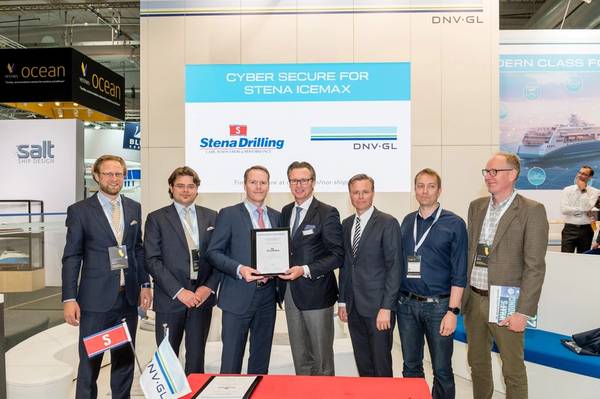
Classification society DNV GL reports it has signed a contract for the first Cyber Secure class notation with Stena Drilling. The contract covers the application of the “Basic+” notation to the drillship Stena IceMAX and includes the vessel’s dynamic positioning, drilling and blowout prevention systems (BOP). It will be integrated with Stena Drilling’s own safety management systems.
“Being cyber secure is an important step towards ensuring the digital integrity of our vessels, making sure that we take all the necessary safety precautions for our personnel and systems,” said Stena Drilling CEO Erik Rønsberg. “It also fits into our strategy of being innovative and ahead of compliance, making our vessels as attractive as possible in today’s demanding market.”
Stena IceMAX, delivered by Samsung Heavy Industries in 2012, is a DP3, dual mast ice-class drillship capable of drilling in water depths up to 3,050 meters. The IceMAX has on board two BOPs, each 18¾” x 15,000 psi Cameron “TL” BOP c/w ST Locks, and uses Cameron Load King riser.
The drillship is currently under contract through the fourth quarter of 2019.
DNV GL’s Cyber Secure class notation establishes a baseline to identify cyber security levels for the main functions of a vessel, either in operation or during construction, and offers owners and operators a framework to improve and demonstrate their cyber resilience. It gives owners and operators the flexibility to identify the threats and to assess and secure extra systems which are of particular importance to their operations.
“The shipping industry needs to build resilience against cyber-attacks, which have proliferated over the past few years. This becomes even more critical as vessels develop higher degrees of autonomy,” said Knut Ørbeck-Nilssen, CEO of DNV GL – Maritime.
The Cyber Secure class notations have three different qualifiers: “Basic”, “Advanced” and “+”. “Basic” is primarily intended for ships in operation, while “Advanced” has been designed to be applied throughout the newbuilding process, with requirements for asset owners and operators, system integrators (e.g. yards), and equipment manufacturers. The “Basic” and “Advanced” qualifiers cover a number of essential systems, including propulsion, steering, navigation, and power generation. The third qualifier, “+”, is intended for systems that are not part of the default scope of “Basic”/”Advanced”.
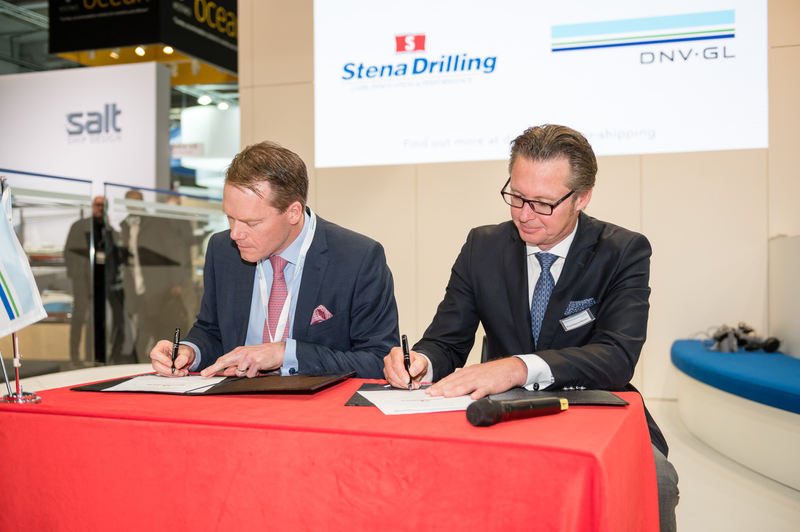 Erik Rønsberg and Knut Ørbeck-Nilssen (Photo: DNV GL)

 Subscribe