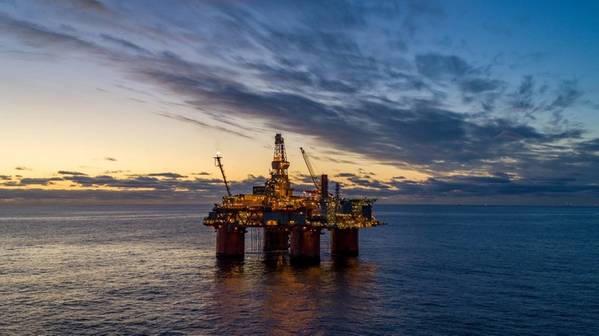
Equinor has scrapped plans to cut greenhouse gas emissions by connecting several offshore platforms to Norway's onshore power grid, the company told the government on Friday, citing soaring costs.
The oil and gas sector is Norway's largest source of climate emissions, accounting for about a quarter of the total. Around 80% of industry emissions come from gas turbines powering offshore installations.
Replacing them with renewable electricity from shore has been a key decarbonisation strategy.
Equinor would no longer pursue electrification of its Snorre A and B, Heidrun, Aasgard B and Kristin platforms, but still plans to proceed with projects at Grane and Balder fields, it said in a letter sent on Friday to the energy ministry and seen by Reuters.
The energy ministry said it had no comments at this time.
Norwegian business news website E24 was the first to report on the letter.
"The costs of electrifying Snorre and the Halten area have become so high that the projects are no longer sufficiently profitable, and we therefore recommend discontinuing them," an Equinor spokesperson said in an email.
The move means Equinor will fall short of a non-binding government target to cut Norway's offshore petroleum emissions by 50% by 2030, reaching 45% instead.
"We will be unable to reach our climate goals if the largest polluter doesn't cut its emissions," Lars Haltbrekken, deputy head of Norway's newly elected parliamentary Energy Committee, told Reuters.
Vaar Energi, Equinor's partner in several fields, said it supported the decision. Electrification of Balder and Grane remains "challenging" but is still progressing, a Vaar spokesperson said.
Equinor estimated the scrapped projects would have cut 710,000 tonnes of CO2 annually. Electrifying Grane and Balder is expected to reduce emissions by 380,000 tonnes of CO2 per year.
Equinor declined to share cost estimates but said they far exceed Norway's CO2 tax, set to reach 2,400 Norwegian crowns ($237.33) per tonne by 2030 in 2025 money.
Harbour Energy, a partner in the Snorre field, estimated that electrification measures would cost up to 5,000 crowns per tonne.
"Whilst electrification can play a role, this should not be at any cost," a Harbour spokesperson said.
($1 = 10.1125 Norwegian crowns)
(Reuters - Reporting by Nerijus Adomaitis and Nora Buli; Editing by Susan Fenton)

 Subscribe