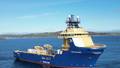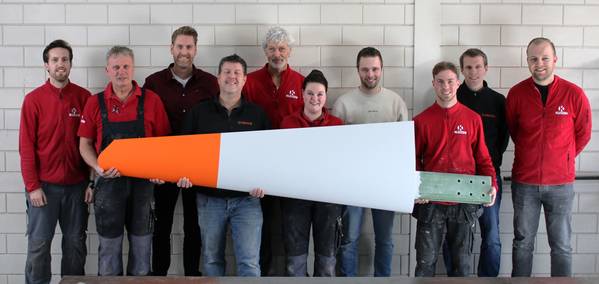
We4Ce, a Dutch rotor blade designer, has designed 10 rotor blade sets for Dutch wind turbine startup TouchWind for testing on its floating TW6 turbine, a self-tilting, one-piece rotor design that breaks from conventional three-blade models.
Engineered to withstand wind speeds of up to 250 km/h, said to be the highest wind class in wind industry standards, the future commercial version is expected to cost significantly less than traditional turbines while delivering higher energy yields.
Responsible for the blade design, We4Ce partnered with Dutch mould specialist Kleizen to produce both the moulds and blades.
TouchWind, backed by its main shareholder, Japan-based Mitsui O.S.K. Lines (MOL), contracted We4Ce as lead partner for the blades.
The delivery of the blades marks the next prototype phase of TouchWind’s innovative tilting, one-piece rotor wind turbine. Featuring a six-meter-diameter rotor designed for efficient energy capture, the 12 kW turbines will be tested onshore and offshore.
The turbines will be placed close to one another to validate the high energy density previously demonstrated in wind tunnel tests. Currently being assembled in Eindhoven, the wind turbine will start testing in the summer.
“We4Ce made a special structural design for the smaller blade compared to the default blades we see nowadays. For the aerodynamic design, the inventor, Rikus van de Klippe of TouchWind, made a novel downwind self-tilting design. The rotor tilts upward, nearly parallel to the water surface at high wind speeds,” said Arnold Timmer, managing director of We4Ce.
The turbine functions similarly to a kite - instead of pushing against the wind like traditional turbines, it ‘lifts itself’ with the wind, using aerodynamic lift to stay stable and to regulate the power. This configuration allows the blade to harness strong winds more efficiently while reducing stress on the structure.
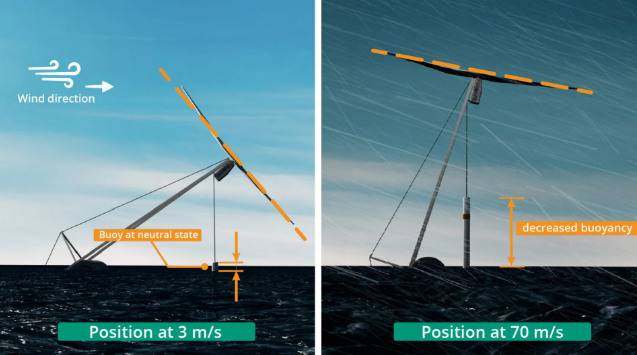 The tilting design allows wind capture also in storms (Credit: TouchWind)
TouchWind’s design not only aims to reduce wind interference between wind turbines, a common issue in large wind farms, but also to improve overall wind farm power generation efficiency, the company claims.
Looking ahead, TouchWind has started development of a 3-5 MW version of the turbine in 2025, aiming to scale its design for future offshore deployment. The wind turbines are suitable for more compact offshore wind farms and could be scaled further in the future.

 Subscribe