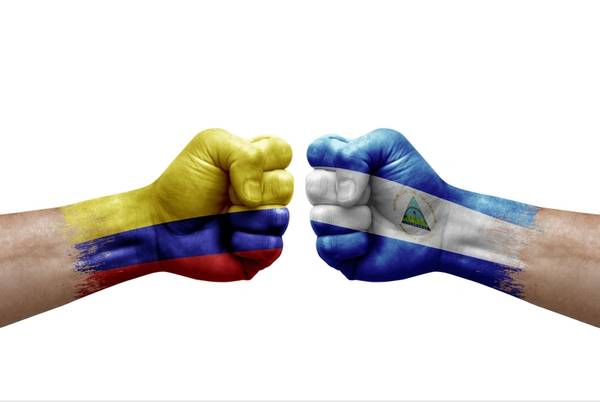
The World Court on Thursday rejected a lawsuit by Nicaragua seeking to define and expand its deep sea economic rights beyond those previously established in a long-running maritime border dispute over a trio of Caribbean islands with Colombia.
Judges at the United Nations-linked World Court, or International Court of Justice, found that Nicaragua's offshore rights to 200 nautical miles (370 km) had previously been established, and rejected its call to extend the boundaries.
"Irrespective of any scientific and technical considerations, Nicaragua is not entitled to an extended continental shelf within 200 nautical miles from the baselines of Colombia's mainland coast," Judge Joan Donoghue, the court's president, said as he read the decision.
Nicaragua's government responded later on Thursday in a statement, stating it recognized the court's ruling as "firm, definitive and mandatory."
Colombian President Gustavo Petro hailed the ruling in a post on Twitter, calling it"a great victory for Colombia."
Nicaragua had asked the World Court to extend its legal offshore boundaries, claiming that its continental shelf under the sea reaches beyond 200 nautical miles from its coastline.
Since the early 20th century, Nicaragua and Colombia have disputed ownership of the mineral and fish-rich waters in the Caribbean Sea, though the two countries do not share a land border.
In a 2012 ruling, the same court determined maritime boundaries between the countries in a decision that reduced the expanse of sea belonging to Colombia and gave Nicaragua rights to some underwater oil and gas deposits, as well as fishing rights.
However, it awarded a series of small islands to Colombia, which Nicaragua disputed.
The Colombian archipelago includes the islands of San Andres, Santa Catalina, and Providencia, the latter of which was severely damaged by a hurricane in November 2021. All three, however, are physically much closer to Nicaragua than to Colombia.
"With this ruling we hope to close the border dispute and focus on bringing sustainable development to our archipelago," Petro said.
(Reuters - Reporting by Toby Sterling in Amsterdam and Oliver Griffin in Bogota; Editing by Barbara Lewis, Alistair Bell and Aurora Ellis)

 Subscribe