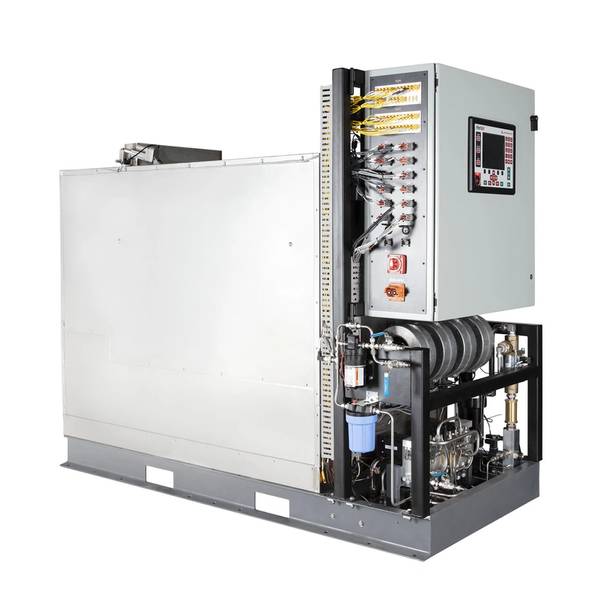
RIX Industries offers a mobile hydrogen generation system, the M2H2-Series scalable family of Methanol-to-Hydrogen Power Systems, bringing green power to shipboard and marine environments.
With the ability to generate hydrogen onboard and on demand, the RIX M2H2-Series also eliminates the heavy footprint of cryogenic liquid hydrogen storage. These highly efficient power systems provide marine shipbuilders and operators a readily available path away from environmentally damaging diesel-based propulsion systems.
Available now, the M2H2-Series systems create an effective commercial path to clean, scalable hydrogen power for maritime applications.
“While hydrogen power technology is globally recognized as critical to reducing pollution and climate change, rugged readymade systems that capitalize on this technology have been absent from the power landscape,” said Bryan Reid, Chief Sales Officer, RIX Industries. “Tapping into the convenience of methanol as a hydrogen carrier, our industry-leading mobile system produces hydrogen safely, efficiently, and as needed – a sea change in hydrogen usability and competitive value for shipbuilders working to minimize their environmental impact.”
RIX M2H2-Series systems incorporate methanol fuel reforming technology to generate hydrogen. This technology is licensed from Element 1 (dba e1), developer of clean energy products, processes, and technologies, and is supported by RIX’s well-established manufacturing operations and integration services. As self-contained containerized power systems, the M2H2-Series blends methanol-to-hydrogen generation technology and PEM fuel cells to provide a high efficiency, minimal vibration/noise, and low emission solution for power critical applications including ship propulsion, auxiliary power systems, reefer container power, and cold ironing. Scalability is another advantage of the M2H2 power system, supporting 30 kW to 120 kW fuel cell solutions, which can be combined to support MW applications as well. Deployment does not require major retrofit of ship infrastructure, and existing diesel tanks can instead be used to store liquid methanol at ambient conditions as a feedstock. This eliminates the complexities and concerns of onboard hydrogen management, such as storage at high pressures or cryogenic temperatures, which have long been a roadblock for marine industries.

 Subscribe