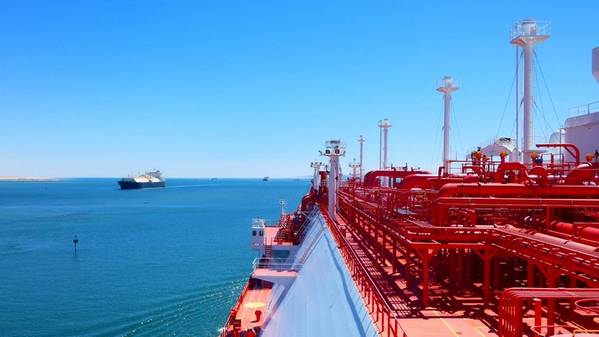
The number of liquefied natural gas cargoes exiting the Strait of Hormuz rose in September to its highest monthly level since the US-Israeli war on Iran began, data from analytics firms, shows, despite persistent security worries and uncertainty.
A total of 19 LNG cargoes were shipped through the key waterway in September, made up of 13 from Qatar and six from the United Arab Emirates, S&P Global Energy said.
That compares with the June figure of 15, when a pact between the US and Iran had started to take effect, said Eric Yep, a senior principal analyst at S&P.
"LNG transits through the Strait of Hormuz accelerated in the second half of September and if this is maintained into October, we could see full-month transits recover to 25% of pre-war levels."
Tally of 21 LNG Cargoes Exited in September, Kpler Says
Data from Kpler shows a total of 21 LNG cargoes exiting the Strait of Hormuz in September, up from 15 in June.
More QatarEnergy-linked liquefied natural gas vessels, laden and in ballast, have transited the strait in recent weeks, despite the conflict.
This week, three more LNG vessels carrying cargoes from Qatar's Ras Laffan export terminal reappeared outside the waterway, Kpler and LSEG ship-tracking data showed.
Two of the vessels are QatarEnergy-linked Al Kharaitiyat and Al Gharrafa. The former was last seen inside the strait around September 22 to September 23 before reappearing off the west coast of India around September 29 to September 30.
It is now going past Sri Lanka.
The second vessel, Al Gharrafa, which disappeared from tracking data inside the strait between September 23 and September 24, reappeared on September 30 off the west of India as well.
The third vessel, the Milaha Qatar, is managed by Germany's Pronav Ship Management, was last glimpsed in the strait between September 17 and September 21, before reappearing west of India on September 30.
It is now offloading its cargo at India's western port of Hazira.
QatarEnergy did not immediately respond to a request for comment, while Pronav Ship Management declined to comment.
Transponders Switched Off for 'Dark Transits'
Many vessels passing through the strait make so-called "dark transits" by switching off their Automatic Identification System (AIS) transponders to avoid detection.
"The key concern is whether LNG transits through Hormuz can be sustained through winter," Yep said.
This hinges on whether Iran would resort to more serious military escalation if higher exports through Hormuz are perceived as loss of leverage in its control of the strait, and whether shipping convoys under US naval escorts can continue despite the high cost, he added.
The Strait of Hormuz carried roughly a fifth of global crude oil and LNG supplies before the war, which began on February 28.
(Reuters - Reporting by Emily Chow and Florence Tan; Editing by Clarence Fernandez)

 Subscribe