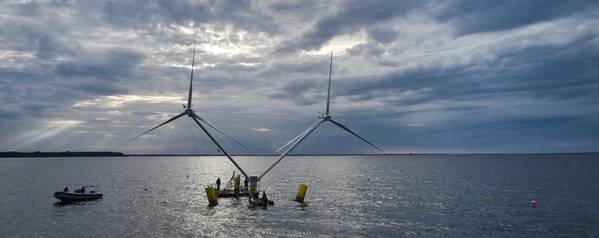
A unique double rotor floating wind turbine concept has earned a statement of feasibility from classification and certification body DNV GL.
This statement, based on DNV GL’s technology qualification services, confirms that the nezzy² floater is designed to state-of-the-art safety, quality and performance standards, and allows its developer, aerodyn engineering, to secure investments and enter the next level of prototype development.
The innovative floater is designed as self-aligning concrete structure attached by single point mooring system to the sea ground. The two turbines are mounted on a lift and drag optimized, lens shaped, guyed tower structure and will generate a total rated power of 15 MW.
“Through the cooperation with DNV GL, we have evaluated the technical and commercial risks of the project within the framework of the Technology Qualification. Now we are able to offer our customers a reliable, forward-looking and economically attractive solution confirmed by a statement of feasibility,” said Jan-Christoph Hinrichs, Project Manager nezzy² at aerodyn engineering.
“Floating offshore wind will be an exciting new market with 250 GW installed, producing 2% of global power in 2050, said Kim Mørk, Executive Vice President Renewables Certification at DNV GL. “Qualification of new technology based on state-of-the-art methods and certification schemes linked to international standards is key in bringing early confidence in the concept to this emerging industry.”

 Subscribe