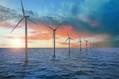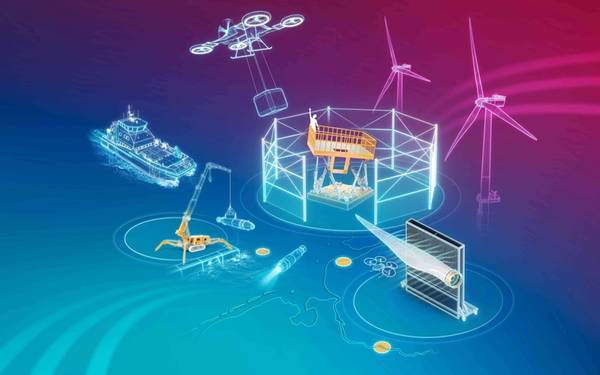
With USD$9.87 million (8.85 million euros) in funding from the Federal Ministry for Economic Affairs and Energy (BMWE), Fraunhofer IFAM is establishing a new research infrastructure for wind energy. The FOKUS-Wind project will create Germany's first end-to-end testing and validation chain for autonomous systems in offshore wind farms across the institute's sites in Bremen, Cuxhaven, and Heligoland. The infrastructure will enable companies and research organizations to develop, test, and qualify drones, robotic systems, and sensors under realistic operating conditions. The aim is to support their reliable and cost-effective use for the inspection, maintenance, and condition monitoring of offshore wind farms.
As offshore wind energy continues to expand, wind farms are being built farther from the coast. This trend increases the complexity, costs, and risks of operation, inspection, and maintenance—activities that already account for a significant share of overall electricity generation costs. Drones, robotic systems, and intelligent sensors can automate workflows, ease the workload of skilled personnel, and make offshore wind farm operations safer and more efficient. However, their widespread deployment depends on suitable facilities for testing and validation under realistic conditions.
Suitable infrastructure for comprehensively testing these technologies under realistic operating conditions is currently lacking. FOKUS-Wind addresses this gap by establishing a large-scale, multi-stage research infrastructure that will enable autonomous systems to be systematically evaluated and qualified for use in typical wind farm scenarios.
End-to-end validation from the laboratory to the North Sea
The heart of FOKUS-Wind is a cross-site validation chain covering the full range of development and testing stages—from laboratory studies to demonstrations under real-world offshore conditions.
At Fraunhofer IFAM in Bremen, a controlled laboratory environment will be established for investigating early-stage developments and interactions between robotic systems and different surfaces under reproducible conditions. This facility will serve as the starting point of the multi-stage testing and validation chain.
The next stage of development and testing will take place at the Offshore Drone Campus Cuxhaven (ODCC). Opened in September 2024, the ODCC provides Fraunhofer IFAM with a testing and development environment for offshore drones that is unique in Europe. A coastal flight zone and dedicated flight corridors over the North Sea enable testing under real-world conditions. As part of FOKUS-Wind, the existing research facility will be expanded to include large-scale test structures. Plans include a nacelle simulator with a movable platform, a transition-piece mock-up, rotor blade segments with defined damage patterns, and a large-volume drone cage.
The Heligoland site forms the final stage of the validation chain. The offshore island offers ideal conditions for demonstrations and long-term testing in real-world offshore conditions.
Qualification, standardization, and certification - the path to industrial application
In addition to supporting research and technology development, the new infrastructure will be available for education, training, and qualification programs. It will provide opportunities to test new workflows, train users to apply emerging technologies, and strengthen knowledge and technology transfer between academia and industry.
The FOKUS-Wind team is also helping to establish the organizational framework required for deploying autonomous systems. This includes developing new operating concepts, integrating digital solutions into existing organizational and operational structures, and advancing coordination and approval processes among operators, service providers, and regulatory authorities. In this way, technical innovations can be developed and evaluated alongside the associated working and collaborative processes under real-world operating conditions.
The test environment will also lay the groundwork for standardized testing procedures and future certification. Manufacturer-neutral interfaces, defined test procedures, and reproducible test conditions are intended to improve the comparability of results and accelerate the development of new systems.
The project has already attracted industry interest and is supported by wind farm operators, industrial companies, certification bodies, and industry associations. FOKUS-Wind will initially run for four years. Thereafter, the infrastructure will remain available on a permanent basis to companies and research institutions as an open platform for testing and evaluating autonomous technologies for offshore wind energy and supporting their industrial deployment.

 Subscribe