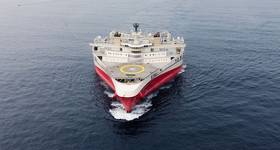
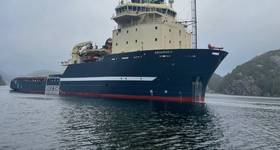
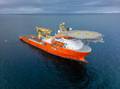
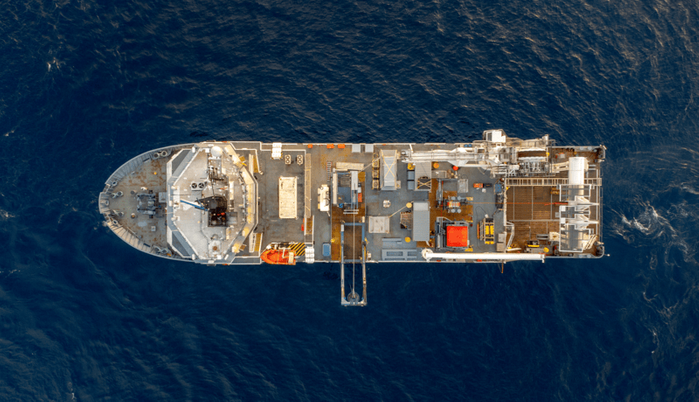
Seattle-based operator Stabbert Maritime has retrofitted its multipurpose support vessel Ocean Guardian with a TechIce® synthetic hoisting system after steel wire rope began constraining crew access and workflow during continuous deepwater operations.


The vessel supports subsea survey and scientific work to depths of 6,000 meters, with lifting systems operating daily rather than intermittently. At those depths and frequencies, the behaviour of the rope started shaping how crews could work on deck, not just how loads were controlled.
Three problems drove the decision to move away from steel. First, snap-back risk required permanent exclusion zones around the line whenever it was under load, forcing task sequencing around the rope rather than around the operation. Second, the lubrication steel wire requires under cyclic loading migrated onto drums, sheaves, and deck surfaces, adding housekeeping burden as lift cycles accumulated. Third, the self-weight of steel wire at deepwater lengths increased stored energy during spooling, empty-hook recovery, and load transitions, requiring greater crew separation during routine handling.
Scaling up the steel-based system was assessed and ruled out. Larger winches, increased deck footprint, and tighter operating margins carried schedule and commissioning risk during transition. "We weren't trying to chase headline performance," said Daniel Stabbert, CTO of Stabbert Maritime. "We needed a system that behaved predictably every day instead of one that people had to keep compensating for."
The replacement system centres on TechIce®, a hybrid synthetic hoisting rope manufactured by Hampidjan incorporating Technora® aramid fibers from Teijin Aramid. The mechanical core is a fully electric deepwater capstan winch designed by Parkburn, an engineering firm specialising in deepwater lifting systems for continuous duty. The architecture separates traction from storage, delivering the required lift capacity within the vessel's existing power envelope and deck footprint without modifications to foundations or auxiliary systems.
Sam Bull, business consultant at Parkburn, said rope performance cannot be assessed in isolation from the system it operates within. "Fiber and rope companies spend most of their time proving their products outperform competitors in isolation, rather than understanding how they behave within the actual deployment and recovery system," he said. "Real performance is governed by the entire operating environment: winch type, sheave geometry, spoolers, fleeting angles, bearing surfaces, system dynamics such as speed and active heave compensation, and the unknown conditions delivered by mother nature."
To validate that view under representative conditions, Hampidjan commissioned independent cyclic bend-over-sheave testing through NORCE Research at the Mechatronics Innovation Lab in Norway. The testing applied repeated cyclic bending at defined speed and elevated ambient temperature without external cooling, to replicate sustained operational loading. Ellen Nordgård-Hansen, senior researcher at NORCE, said the focus on heat and fatigue progression was deliberate. "Cyclic bending and heat are the primary drivers of hoisting rope degradation in practice," she said. The test programme evaluated multiple response parameters rather than a single performance metric, allowing side-by-side comparison of different rope configurations under the same degradation conditions.
On Ocean Guardian, the crew noticed the difference during the first operational period. Spooling and empty-hook recovery settled into routine, and line behaviour remained consistent across load changes. During extended periods of active heave compensation, the rope generated neither the heat nor the deck contamination associated with steel wire under the same conditions.
No lubricant transferred to deck surfaces, and lower line mass reduced the managed energy during handling. Tasks that would normally be delayed or re-sequenced around lifting activity ran concurrently. "What stood out was how little attention the system needed once it was running," Stabbert said. "We weren't constantly adjusting how we worked around it."
As deepwater operations extend in duration and involve more frequent lifting cycles, the gap between systems that integrate quietly into daily workflow and those that impose continual adjustments on surrounding work becomes commercially significant. For operators planning extended deepwater programmes, everyday system behaviour may matter as much as peak rated capacity.
TechIce® is manufactured by Hampidjan and incorporates Technora® aramid fibers supplied by Teijin Aramid. The deepwater capstan winch was designed by Parkburn.


 Subscribe