Airborne Oil & Gas has started a project to qualify thermoplastic composite pipe (TCP) for a deepwater jumper spool application for French operator Total.
The non-corrosive and spoolable TCP aims to provide cost effective spools, well jumper, flowline and riser solutions to deal with corrosive fluid conditions and deepwater environments. For the deepwater spool application, the TCP offers the possibility to save time and cost due to the flexibility of the product. TCP allows installation without high-precision subsea metrology, as is the case for rigid steel spools. The TCP that will be qualified on this project targets deepwater applications.
“The possibility with TCP to handle large deflections, the ability to cut-to-length and terminate the pipe at location and the subsequent installation with small vessels, make a compelling business case for TCP jumpers,” said Frédéric Garnaud, research and development deep offshore program manager, Total. “We estimate we can achieve considerable cost savings by using TCP jumpers.”
Client Total foresees the first application by the company to be for water injection well jumpers.
Airborne has been working with Total in the development of TCP since the start of the Cost Effective Riser Thermoplastic Composite Riser joint industry project in 2009.
The project includes the manufacturing and qualification testing of full-scale (6in inner diameter) prototypes and is planned to deliver qualification to DNV GL standard RP-F119 in Q1 2017.
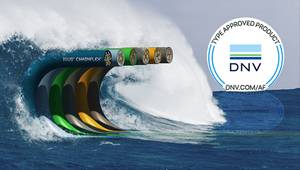
Image: Thermoplastic composite pipe/Airborne Oil & Gas

 Subscribe