A wave of new investment in dedicated shuttle tankers has been spurred by the age profile of the existing fleet coupled with surging developments in the Brazilian offshore market.
Constituting a specialized asset class, dynamic positioning (DP) shuttle tankers are a flexible and cost effective way of lifting and transporting oil from offshore fields, where subsea pipelines are not a practical or economically viable option.
Production platforms or floating units are increasingly located in deepwater areas prone to challenging weather and hydrological conditions, and where high extraction rates generate demand for consistent, dependable service in transporting crude oil and condensate to refineries and terminals ashore.
Tailored to a niche segment of the offshore oil delivery chain, shuttle tankers command a substantial premium in capital cost, reflecting a technical specification aimed at ensuring the highest standards in operational and environmental performance, redundancy and maintenance regime. Moreover, exacting parameters regarding maneuvering and position keeping when loading (over the bow) in open waters, be it in high sea states and raging winds, place a particular imperative on crew competence alongside equipment and system grade.
The requirement for replacement of older tonnage and for a new generation of vessels meeting charterer’s ever-stricter environmental criteria, together with Brazil’s aggressive expansion of deepwater oil production capacity, are stimulating a wave of investment in dedicated tonnage. The current tranche of high valued added contracts is yielding fresh business for South Korean yards well experienced in the sector, but increasingly also for China’s ascendant builders.
 Digital rendering of a 154,000dwt shuttle tanker ordered by AET of Singapore and specified with ethanol-ready main propulsion plus a battery bank for peak shaving. (credit: DSIC Dalian Shipbuilding Industry Co).
Energy corporations are the primary long-term charterers of shuttle tankers, in a regulatory sphere more akin to the offshore oil and gas industry than shipping. Environmental rating is accordingly critical and colors engineering design for the incoming new generation.As vessels are subject to very high and constantly fluctuating electrical loads when handling cargo and keeping station offshore, thus spending extended periods in DP mode, energy efficiency is equally a major factor influencing technical concept and specification.
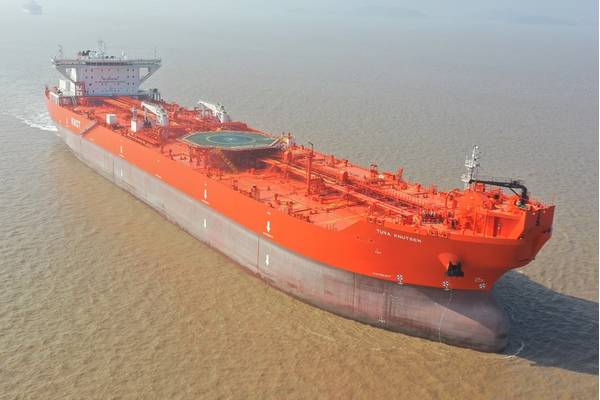
Market leader Knutsen NYK Offshore Tankers (KNOT) is in the midst of a vigorous investment program, and has augmented its order tally this year at COSCO Heavy Industry (Zhoushan). The 2026-2028 period is scheduled to see a total of nine newbuild entrants to the fleet, underpinned in each case by long-term charter assignments, primarily involving Brazilian clients.
In its business report for the opening quarter of 2026, KNOT stated that Petrobras had continued to set production records with an emphasis on fields that depend upon regular shuttle tanker service. The Brazilian major has continued to both bring new FPSOs on-line ahead of schedule, and to commit to additional FPSO contracts with deliveries now extending over several years.
Illustrative of the considerable expansion in Brazilian offshore development, an entire newbuild series of DP2 Suezmax shuttle tankers ordered on the Korean peninsula by the Tsakos Group has been committed to Transpetro, the logistics arm of Petrobras. Nine 155,000dwt vessels entrusted by Tsakos Energy Navigation (TEN) to Samsung Heavy Industries have each been fixed for 10 years plus an optional five years.
The first two vessels are scheduled to be completed during the second half of 2027, with the subsequent seven due over the course of 2028, and will virtually double Transpetro’s platform offloading capacity. The design incorporates preparation for alternative fuels such as methanol and ethanol, plus shore electrical power connections. Each tanker has been specified with five manoeuvring thrusters, producing a combined 14,000kW hull rotation power, sourced from the Norwegian maker Brunvoll.
Two 154,350dwt shuttle tankers of similar design were brought into service by the Greek company from Samsung during 2025, and commissioning of a third-of-class was expected in the 2026 third quarter.
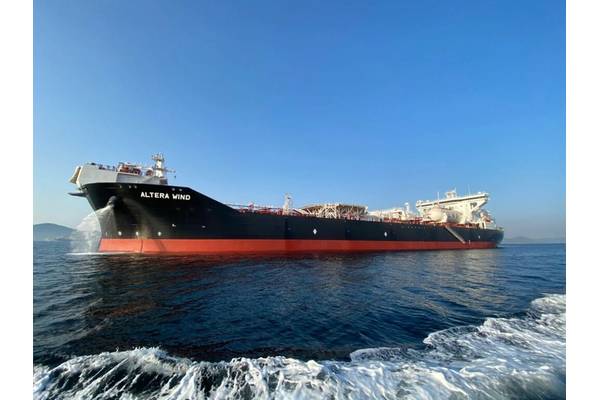
Reflecting the particular operational, technological and regulatory edicts that impose a high threshold for market entry, the number of players engaged in the offshore loader business is few. Against this backcloth, the Angelicoussis Group has recently emerged as a major force. Having shown its intent by awarding a three-ship shuttle tanker order to Daehan Shipbuilding of South Korea in early 2024, the Greek organization acquired Altera Shuttle Tankers and its 18-strong fleet in January 2025, rebranding the entity as Maran Shuttle Tankers.
The design legacy embodied in the former Altera vessels reflects predecessor Teekay Offshore, which had been a leading light in shuttle tanker development. The trio of 154,000dwt DP2 Korean newbuilds is due to be completed between November 2026 and May 2027, for assignment on long-term charter to Petrobras.
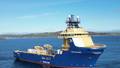
 Two 154,350dwt DP2 shuttle tankers were completed in 2025 by Samsung Heavy Industries for Tsakos Energy Navigation (TEN). (credit: TEN).
Singapore-domiciled AET, part of Malaysian group MISC Berhad, deploys some 17 DP shuttle tankers in Brazilian and Norwegian offshore waters, and has this year ordered a 154,000dwt DP2-class newbuild from Dalian Shipbuilding Industry Co (DSIC). Due for delivery in 2028, and fixed on long-term charter, the vessel is distinguished by the nomination of ethanol-ready, dual-fuel propulsion and an energy storage system.
While AET already offers a dual-fuel capability across-the-board, the addition of hybrid propulsion further broadens lower-emissions optionality for customers. The rationale for including ethanol within the prospective fuel range of the newbuild is that this offers a relatively high energy density as a renewable fuel while significantly reducing CO2 and SOx emissions.
The hybrid electric propulsion element conferred by incorporating batteries will allow for peak shaving of sudden electric load fluctuations during dynamic positioning, enabling the main engines to be run at a constant, optimum speed.
The assignment of the latest phase of fleet development to a Chinese yard follows the company’s award of two LNG dual-fuel Suezmax shuttle tankers to Samsung Heavy Industries in late 2025.
DSIC first demonstrated Chinese shipbuilding’s capability to make the transition from large crude oil carriers to the highly specialized shuttle tanker domain by delivering the 155,000dwt DP-equipped NS Pioneer to China National Offshore Oil Corporation (CNOOC) in 2023. The self-reliance expressed in the home-grown design and construction project is claimed to extend to certain Chinese intellectual property rights. NS Pioneer was followed out of Dalian a year later by sistership NS Explorer. Both vessels were assigned from the outset to liftings from Brazilian deepwater offshore fields.
Prominent deep-sea crude carrier operator China Merchants Energy Shipping (CMES) is also adding another string to its bow by entering the shuttle tanker segment, and has selected DSIC to realize its opening gambit. The deal struck in the closing stages of 2025 calls for construction of a DP2-class Suezmax shuttle tanker, to be delivered by the end of September 2028 to CMES subsidiary Associated Maritime Company (Hong Kong).
An option on a second ship is appended to the contract. Industry sources suggest that the vessels will be tied to offshore operations in South America under long-term charter.

 Subscribe