Netherlands-based lightweight fibre specialist DSM Dyneema believes a recent ultra-deepwater recovery operation amply justifies its trademarked claim to have ‘the world's strongest fibre'.
A salvage operation on a ship wreck in 3200m of water in the South Atlantic was successfully carried out using lightweight ropes make with the Dyneema ultra-high molecular weight polyethylene fibre. It is used by fishing gear and ‘super rope' manufacturer Hampidjan to make Dynex Warp, an advanced patent-pending winch line for deepwater lifting and lowering as well as for towing fishing trawls.
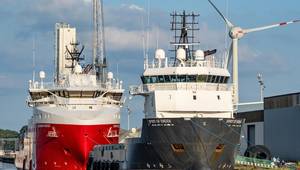
The Dynex Warp rope was used over several months on the MV Seabed Worker in a salvage operation to rescue valuable cargo from a sunken ship.
Steel rope was ruled out in these water depths on vessel stability and deck load capacity grounds since it would have had a weight in the water of over 35t. By contrast, the Dynex Warp rope – with relative density of 1.1 – is said to weigh just 740kg. ‘Out of the water, 4.2km of the Dynex Warp rope weighs 6.5t, against around 50t for the same length of steel rope with the same strength,' reports DSM Dyneema. Indeed, Seabed Worker (pictured) holds a 6000m-long Dynex Warp rope for future operations, and its operator, the Norwegian Seabed Group, believes this is a viable proposition without needing to switch to a larger winch and thus a larger vessel.
According to Seabed, over the several months it has been using the Dynex Warp rope for the current operation, on a standard drum winch with an electronically controlled spooling system, it has experienced no problems at all with the spooling, even though the rope has a high number of layers on the drum.
The version of Dynex Warp used in this operation is a 12-strand braided rope with a diameter of 46mm, claimed to have the same strength as a steel rope with the same diameter. With its six different layers providing high cross-sectional stability and axial stiffness, this rope is reported to have shown very little elongation even when recovering heavy loads from over 3km below. OE

 Subscribe