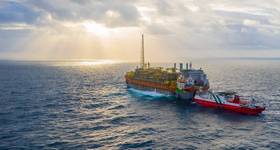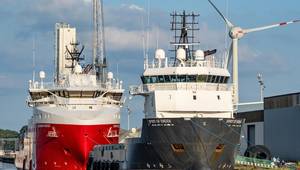
Marine robotics company Ocean Infinity has completed its survey project for ExxonMobil, within the enormous Stabroek block offshore Guyana, where the oil giant has over the recent few years discovered more than 8 billion barrels of oil.
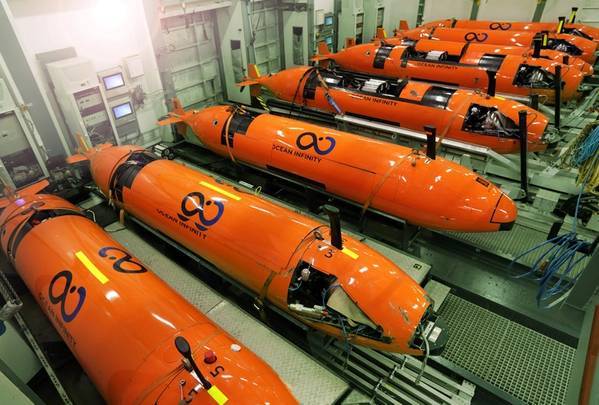
The project, announced in February, involved acquiring high-resolution geophysical and geotechnical data through the simultaneous deployment of multiple Autonomous Underwater Vehicles (AUV), in water depths of between 70m and 2150m over an area of approximately 3,100 square km.
The Stabroek Block itself, located approximately 120 miles offshore Guyana, is 6.6 million acres (26,800 square kilometers) big and is equivalent in size to 1,150 typical U.S. Gulf of Mexico blocks.
"The approach of autonomous operations at scale ensured that the data was gathered at an industry-leading pace and with a significant reduction in environmental impacts compared to conventional survey methods," Ocean Infinity said.
The company has recently expanded its AUV fleet and implemented new battery technology to make operations more environmentally friendly.
Josh Broussard, Ocean Infinity's CTO, said: "The successful completion of this project for ExxonMobil in Guyana is further evidence of our ability to sustainably deliver the highest quality results to our clients using our cutting-edge robots.
"We are constantly striving to push technological boundaries so that we can rapidly deliver high-quality results, and the upcoming deployment of our Armada fleet in January 2021 is further testament to this," Broussard said.
As for the Armada, it is a new marine tech company launched by Ocean Infinity, which will boast the industry's largest fleet of unmanned surface vehicles (USV).
Armada's fleet is currently under construction and is expected to be deployable by the end of 2020.
Each unmanned surface robot will serve a wide range of industries by being fully equipped to perform a multiplicity of offshore data acquisition and intervention operations down to a depth of 6,000 meters. These robot ships will be capable of remotely deploying a wide range of the latest sensors as well as AUVs and remotely operated underwater vehicles (ROV) for visual and acoustic data acquisition.

 Subscribe