MacGregor, part of Cargotec, has developed an offshore crane featuring three-axis motion compensation to carry out installations, repairs, maintenance and general service duties in the renewable energy and oil and gas markets
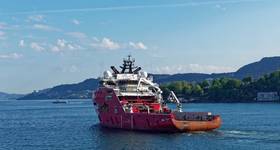
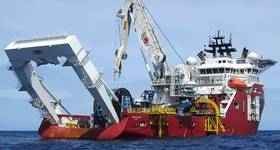
A 74m infield support vessel (ISV) will debut a new MacGregor offshore crane that delivers full three-axis (x, y and z) compensation, enabling equipment to be landed on small, high platforms with little margin for error. Siem Moxie is under construction at Fjellstrand shipyard in Norway and will operate in the offshore renewable energy and oil and gas markets for Siem Offshore. The crane has a safe working load of 5 tonnes at a 25m outreach; delivery is scheduled for January 2014.
"This crane is a first of its kind, not just for MacGregor, but for the offshore industry," says Frode Grøvan, Director, Sales and Marketing, Advanced Load Handling. "Siem Offshore approached MacGregor's Competence Centre for Advanced Load Handling, Offshore in Kristiansand, Norway, to develop the crane especially for the vessel."
One specific task for Siem Moxie will be to transfer equipment to the top of offshore windmill foundations to install power cables and other apparatus used for windmill installation and maintenance.
"The landing platforms are about 20m above the water and they are only 4m2, so precise load handling is essential," says Mr Grøvan. "Although MacGregor's standard active heave compensation (AHC), supplied through a crane's winch, compensates for a vessel's vertical movements, a greater degree of precision was required in this case."
The crane, which has a hydraulically-tilting foundation, is mounted at the centre point of the vessel. "Although all areas of the vessel experience the same angular movements in a seaway, positioning the crane at the centre of the vessel minimises the actual physical displacement of the crane and its load," explains Mr Grøvan. "The tilting foundation compensates for pitch and roll, maintaining the crane pedestal vertical with respect to the sea bed; active heave compensation provides the third degree of stabilisation."
A motion reference unit (MRU) will be the primary sensor for calculating heave motion. In addition, a secondary sensor placed at the crane boom tip will be used to verify the MRU's accuracy and provide overall redundancy, adding to the system's safety.

 Subscribe